Indian Textile Guide & Identifier
Discover the rich heritage of Indian weaving. Select your preferences below to find the perfect traditional fabric for your needs.
You walk into a shop in New York or London, see a vibrant famous Indian textiles sari, and wonder: where did this come from? It’s not just one thing. India isn’t a single factory; it’s a continent of weaving traditions. When people ask which textile is famous in India, they’re usually thinking of the shiny gold-threaded saris worn at weddings. But that’s just the tip of the iceberg.
The truth is more interesting. India’s textile fame rests on three pillars: luxury silks, everyday cottons, and the revolutionary political fabric known as Khadi. Each has a specific origin, a unique manufacturing process, and a distinct place in global fashion. If you are a buyer, a designer, or just curious about where your clothes come from, understanding these categories helps you navigate the market without getting lost in jargon.
Why India Remains a Global Textile Powerhouse
Before we pick a favorite, let’s look at the scale. India is the second-largest producer of textiles and garments in the world. We also hold the largest stock of raw cotton and produce the most jute globally. This isn’t an accident. The climate supports cotton farming, and centuries of skill development created a workforce that can handle everything from coarse burlap to microscopic silk threads.
What makes Indian textiles stand out isn’t just volume-it’s variety. In China, you might find efficient mass production. In Italy, you find high-end wool. In India, you find handwoven complexity that machines still struggle to replicate. The sector employs over 45 million people directly. That means when you buy an Indian textile, you are often supporting a family tradition that goes back generations.
Banarasi Silk: The Crown Jewel of Luxury
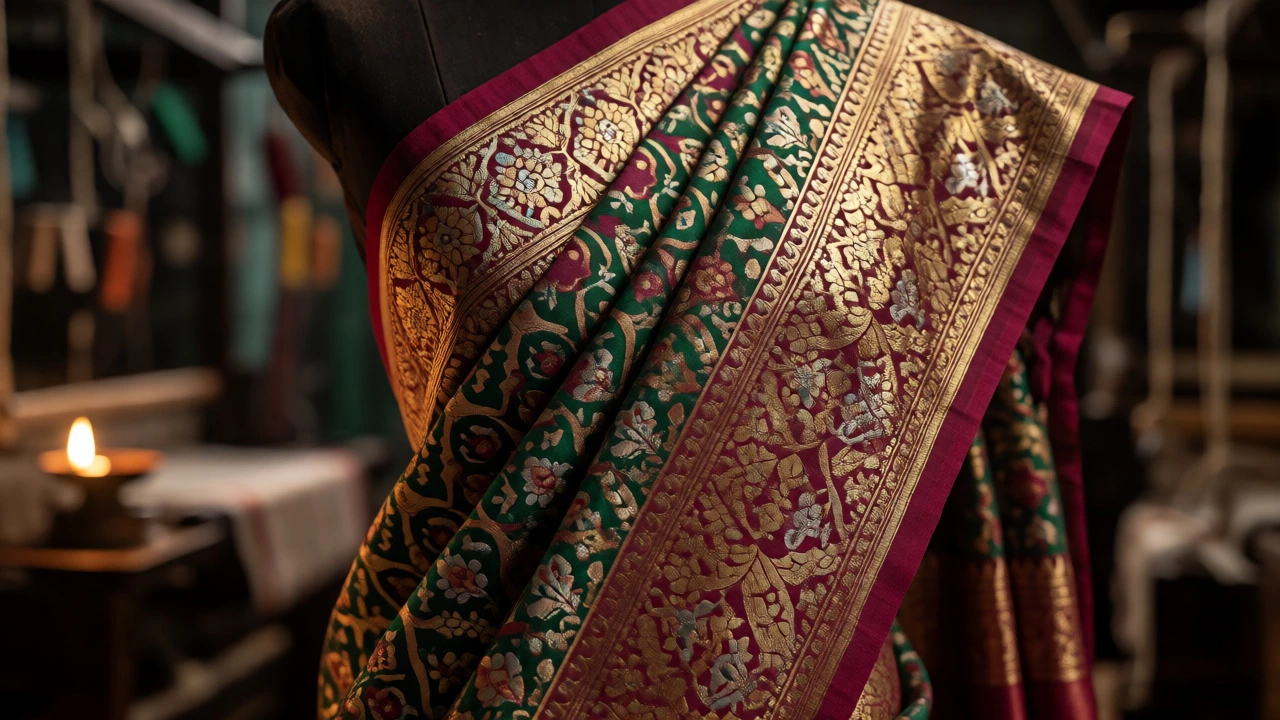
If you had to name just one fabric that screams "India" to the rest of the world, it would likely be Banarasi Silk. Defined as a fine silk fabric originally made in Varanasi (also known as Benares) using gold and silver brocade or zari work, this textile is synonymous with opulence.
Varanasi, located in Uttar Pradesh, has been weaving silk for centuries. The artisans here use traditional handlooms, not power looms. Why does this matter? Because handloom silk has a natural irregularity and depth that machine-made fabric lacks. The designs are intricate, often featuring Mughal-inspired motifs like kalga, bel, and jaal.
There are four main types of Banarasi silk, each varying in weight and thread count:
- Katan Silk: Made from pure mulberry silk threads. It’s lightweight and glossy, perfect for summer weddings.
- Organza (Kora): A sheer fabric with a matte finish. It looks delicate but is surprisingly durable.
- Georgette: Lighter than Katan, with a slightly crinkled texture. It drapes beautifully.
- Shattir: A heavier weave, often used for winter wear or structured garments.
Buying authentic Banarasi silk requires a keen eye. Real pieces have a Geographical Indication (GI) tag. Without this tag, you might be buying a synthetic imitation from Surat or even China. The GI tag guarantees the fabric was woven in the designated region using traditional methods.
Khadi: The Fabric of Freedom and Sustainability
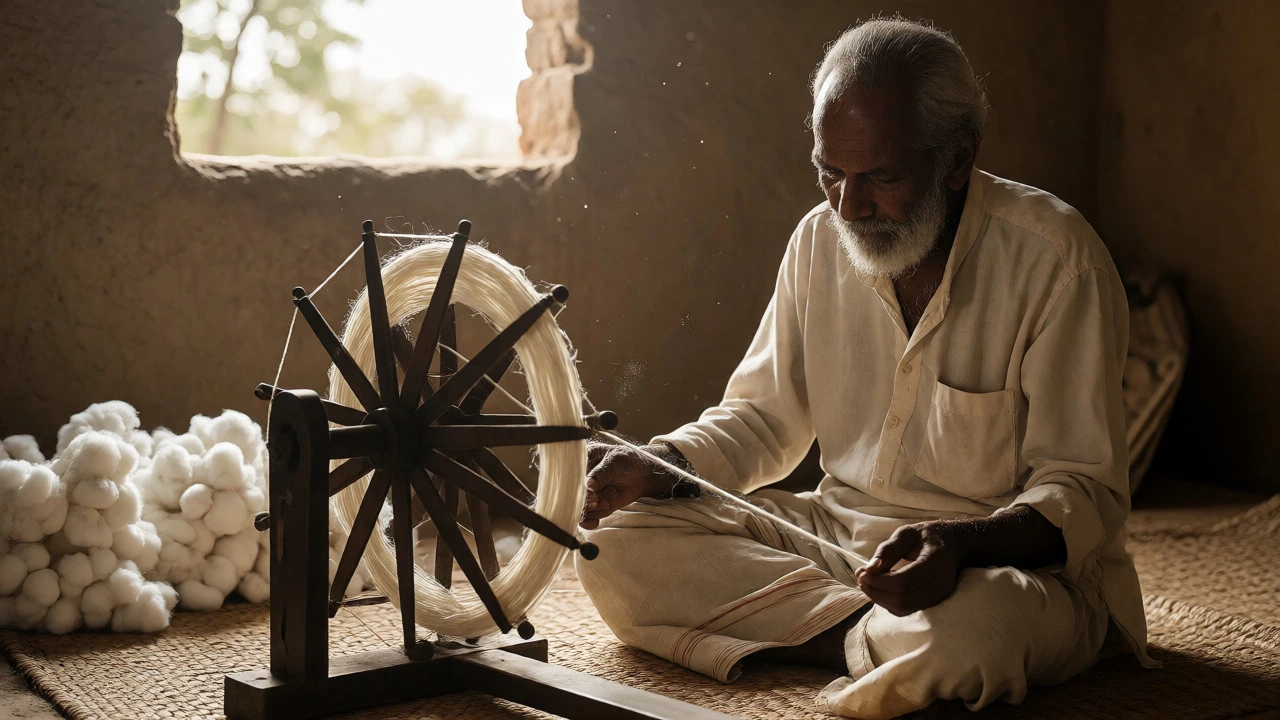
While Banarasi silk represents wealth, Khadi represents resistance. It is hand-spun and hand-woven cloth, typically made from cotton, silk, or wool fibers spun into yarn on a spinning wheel called a charkha.
Mahatma Gandhi championed Khadi during the Indian independence movement. The idea was simple: if Indians wore British-manufactured mill cloth, they were funding their colonizers. By spinning their own yarn and weaving their own fabric, they gained economic self-reliance. Today, Khadi is having a massive resurgence, not just for political reasons, but because it is eco-friendly.
Here is why modern consumers love Khadi:
- Breathability: The open weave allows air to circulate, making it ideal for hot climates.
- Sustainability: It requires no electricity for spinning or weaving. The carbon footprint is negligible compared to industrial fabrics.
- Durability: Contrary to popular belief, good Khadi gets softer and stronger with every wash.
However, Khadi is tricky to manufacture. The yarn thickness varies naturally, so the fabric isn’t uniform. Some buyers dislike this "imperfection," calling it rough. Designers who embrace it, however, create stunning minimalist collections that highlight the texture. If you are looking for ethical fashion, Khadi is the top contender.
Cotton Varieties: From Coarse to Couture
India produces all kinds of cotton, from short-staple varieties for towels to extra-long-staple for luxury shirts. Two regions dominate the conversation here: Gujarat and Tamil Nadu.
In Gujarat, specifically around Ahmedabad and Surat, you’ll find the heart of India’s cotton processing industry. Surat is often called the "Silk City," but its cotton blends are equally famous. They produce affordable, trendy fabrics that feed the fast-fashion supply chain worldwide.
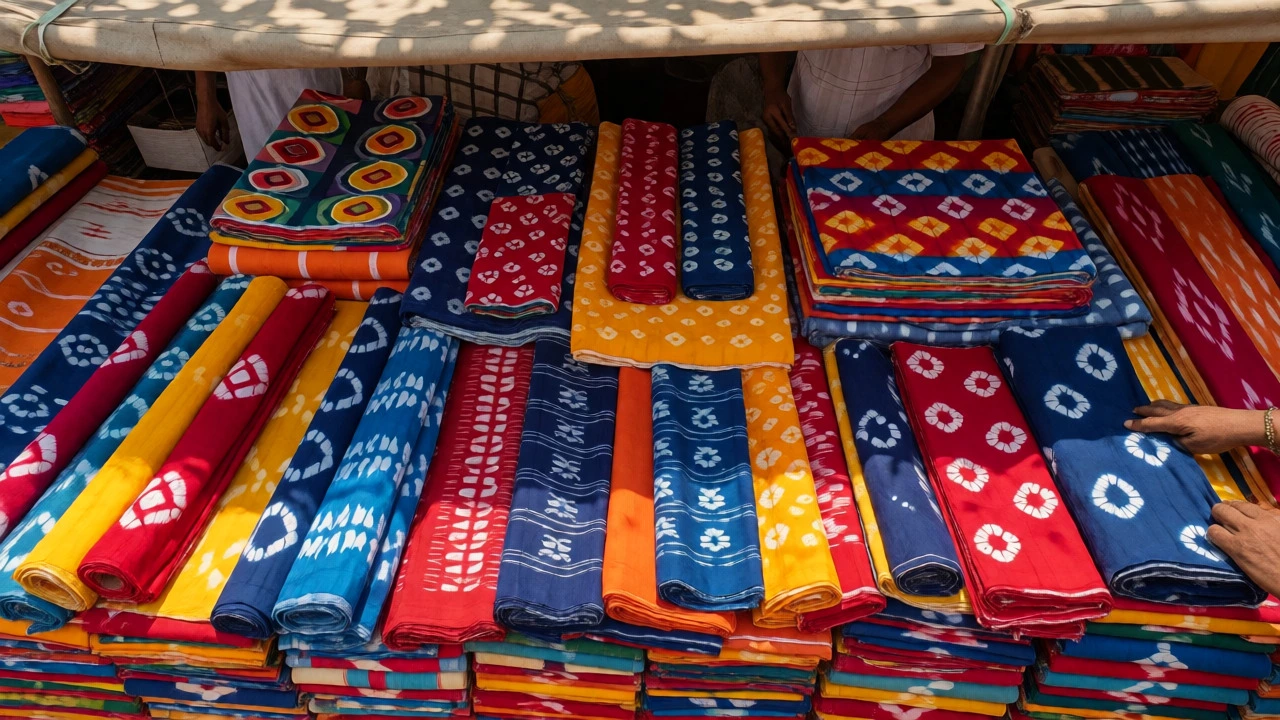
Tamil Nadu, particularly the city of Madurai, is famous for Madurai Sungudi, a traditional tie-dye cotton fabric known for its vibrant colors and geometric patterns. Unlike the solid-colored Khadi, Sungudi uses a resist-dyeing technique where the cloth is tied in small knots before being dipped in dye. This creates distinctive white spots against colored backgrounds.
Another key player is Pochampally Ikat, a geometric-patterned fabric produced in Telangana using a double-ikat technique where both warp and weft threads are dyed before weaving. While technically a silk-cotton blend often, the cotton versions are incredibly popular for daily wear due to their bold, abstract designs.
Regional Specialties You Should Know
Reducing Indian textiles to just silk and cotton misses the regional diversity. Here are a few others that have carved out niches in the global market:
| Textile Name | Primary Region | Key Material | Best For |
|---|---|---|---|
| Banarasi Silk | Uttar Pradesh | Silk & Zari | Bridal Wear, Luxury Events |
| Khadi | Nationwide (Gujarat/Karnataka hubs) | Cotton/Silk Blend | Summer Wear, Eco-Fashion |
| Kanjeevaram | Tamil Nadu | Heavy Mulberry Silk | Traditional South Indian Weddings |
| Pashmina | Jammu & Kashmir | Changthangi Goat Wool | Luxury Shawls, Winter Accessories |
| Leheriya | Rajasthan/Gujarat | Cotton/Silk | Lightweight Saris, Scarves |
Kanjeevaram (or Kanchipuram) silk is the rival to Banarasi in the south. While Banarasi uses lighter zari, Kanjeevaram uses thick gold borders and contrasting pallus (the end piece of the sari). It is heavier and stiffer, designed to hold shape during long wedding ceremonies.
Pashmina comes from the Changthangi goat in Ladakh. The fiber is ultra-fine, measuring between 12 to 16 microns. For context, human hair is about 70 microns. This makes Pashmina incredibly soft and warm. However, beware of fakes. Many "Pashmina" shawls sold abroad are actually Merino wool or viscose. Authentic Pashmina will pass through a ring-a test of fineness-though this is harder to verify online.
The Modern Manufacturing Landscape
If you are looking to source these fabrics, you need to understand how they are made today. The industry is split between unorganized handloom sectors and organized mill sectors.
The handloom sector accounts for about 95% of the total production of handloom fabrics. These are small-scale units, often family-run. Working with them means dealing with longer lead times and inconsistent quality batches. You cannot order 10,000 meters of identical Khadi overnight. You have to plan months ahead.
The mill sector, concentrated in cities like Mumbai, Chennai, and Ludhiana, offers consistency. Ludhiana, for instance, is the knitwear capital of India. If you want t-shirts, sweatshirts, or fleece, this is where you go. The machinery is automated, output is high, and prices are competitive.
For startups and small brands, a hybrid approach works best. Source basic cotton knits from Ludhiana mills for volume, then add value through local embroidery or block printing done by hand in Jaipur or Bagru. This gives you the reliability of industrial production with the uniqueness of artisanal craft.
How to Identify Quality Indian Textiles
Don’t rely on labels alone. Here is a quick checklist for buyers:
- Check the Thread Count: For cotton, higher thread counts mean finer fabric. For silk, look for a smooth sheen, not a plastic-like gloss.
- Inspect the Selvedge: The finished edge of the fabric. In handlooms, the selvedge often has a different color or pattern, indicating it was woven on a traditional loom.
- Feel the Weight: Good silk should feel light despite looking rich. Heavy silk might indicate poor quality dyes or lower-grade fibers.
- Look for the GI Tag: As mentioned earlier, Geographical Indication tags are your best friend for authenticity.
Remember, natural fibers wrinkle. If your "pure cotton" shirt never wrinkles, it’s likely blended with polyester. Embrace the wrinkle-it’s proof of nature.
Which is the most expensive textile in India?
The most expensive textiles are typically pure Banarasi silks with real gold zari and authentic Pashmina shawls from Kashmir. A single handwoven Banarasi sari with genuine gold threads can cost upwards of $1,000 to $5,000 USD, depending on the intricacy of the design and the purity of the materials.
Is Khadi better than regular cotton?
"Better" depends on your needs. Khadi is more breathable and sustainable because it is hand-spun and hand-woven, requiring less energy. However, it is less durable than tightly woven mill cotton and requires careful washing. For hot weather and eco-consciousness, Khadi wins. For durability and ease of care, standard mill cotton is superior.
Where do I buy authentic Indian textiles wholesale?
For silk, visit Varanasi (UP) or Kanchipuram (TN). For cotton and synthetics, Surat (Gujarat) is the biggest hub. For knitwear and sweaters, Ludhiana (Punjab) is the primary center. Always request samples before placing bulk orders, as quality can vary significantly between vendors.
What is the difference between Ikat and Bandhani?
Both are tie-dye techniques, but they differ in application. Ikat involves tying the threads (warp or weft) before weaving, resulting in blurred, feathered edges. Bandhani involves tying the already woven fabric in tiny knots before dyeing, creating sharp, distinct dots. Ikat is complex and time-consuming; Bandhani is labor-intensive but produces clearer patterns.
Are Indian textiles suitable for export?
Yes, absolutely. India is one of the top exporters of textiles globally. Major markets include the USA, EU, and UAE. Buyers appreciate the craftsmanship and variety. However, exporters must ensure compliance with international standards like OEKO-TEX for chemical safety, especially for products intended for the European market.