
India Semiconductor Supply Chain Explorer
Click on a country below to reveal detailed insights into their role in India's semiconductor import landscape.
Supply Chain Insights
Select a supplier to analyze their specific contribution to Indian manufacturing sectors like IoT, Automotive, and Telecom.
China: The Volume Giant
Primary Chip Types
Mature nodes, Passive components, Basic ICs
Major Indian Industries Served
Consumer Electronics, LEDs, Toys
Key Insight
China remains the largest single source by volume, particularly for lower-end components. It serves as a massive assembly hub, often re-exporting chips made elsewhere after final testing.
Supply Chain Risk
Geopolitical tensions, Logistics bottlenecksSourcing Tip
Use for cost-efficient standard parts but qualify a second supplier from Vietnam or Malaysia to mitigate "China Plus One" risks.
You’re sitting in a boardroom in Bangalore or Pune, staring at a bill of materials for your new IoT device. The microcontroller is the brain, but where did that tiny piece of silicon actually come from? It’s a question most engineers don’t ask until customs delays hit their timeline. Here’s the reality: India doesn’t manufacture enough advanced chips domestically yet. We import almost all of them. But who exactly is sending those boxes across the border?
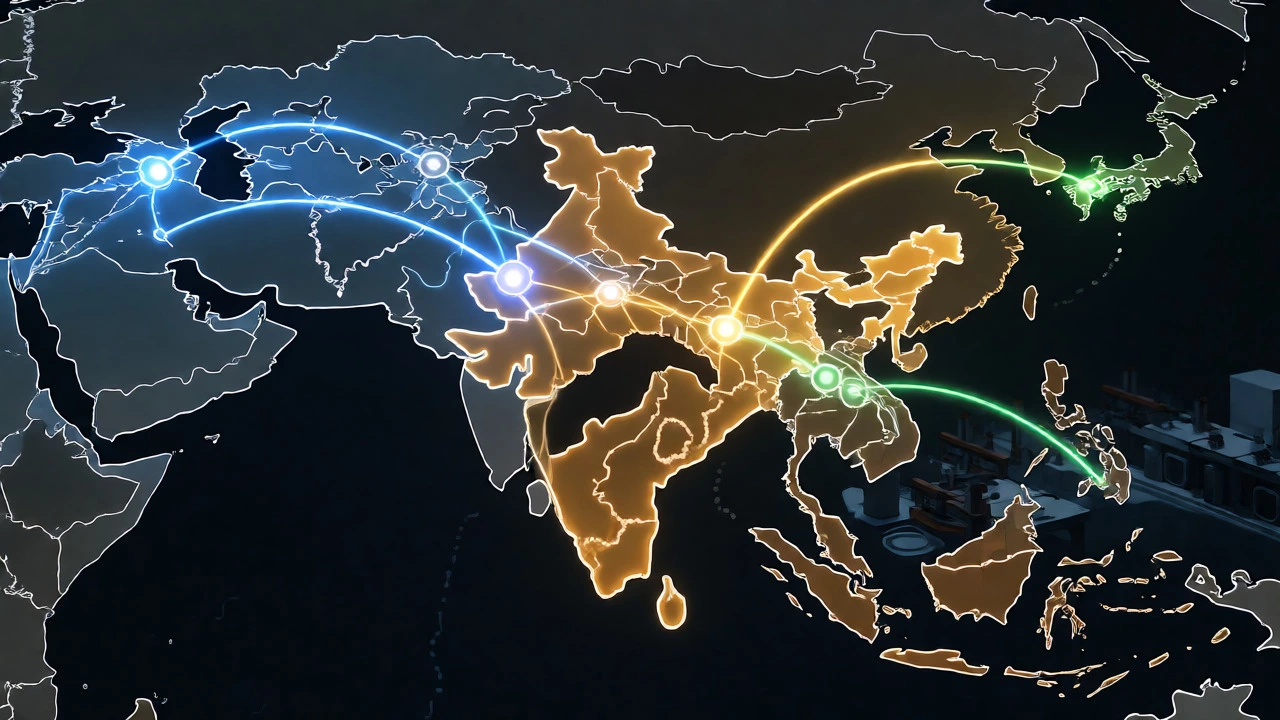
If you think it’s just China, you’re missing half the picture. While China is huge, the top countries importing semiconductors to India include South Korea, Taiwan, Malaysia, and the United States. Each plays a different role. One sends memory, another sends logic processors, and a third handles the packaging. Understanding this map isn’t just trivia; it helps you predict price spikes, manage supply risks, and negotiate better contracts.
The Big Players: Who Dominates India’s Chip Supply Chain?
Let’s cut through the noise. When we look at trade data from the Directorate General of Commercial Intelligence and Statistics (DGCI&S) and recent industry reports up to 2026, a clear hierarchy emerges. These aren’t just random suppliers; they are strategic hubs with specific strengths.
China remains the largest single source by volume, particularly for lower-end components and mature-node chips used in consumer electronics like LED drivers and basic power management ICs. However, its share has slightly dipped as companies diversify. China serves as a massive assembly hub, often re-exporting chips made elsewhere after final testing.
Then there’s South Korea. If your device needs memory-RAM, NAND flash, or DRAM-it almost certainly came from here. Samsung and SK Hynix dominate this space globally, and India’s smartphone and server markets rely heavily on Korean memory modules. They also export significant volumes of display drivers and image sensors.
Don’t overlook Taiwan. This is the heart of high-performance logic. TSMC, the world’s biggest foundry, manufactures the cutting-edge processors found in premium smartphones and AI accelerators. While many of these chips are packaged in Southeast Asia, their origin traces back to Taiwanese fabs. For any Indian startup building edge-AI devices, Taiwan is non-negotiable.
Southeast Asia’s Critical Role: Malaysia and Vietnam
You might be surprised to see Malaysia so high on the list. In fact, it’s often the second or third largest supplier depending on the quarter. Why? Because Malaysia is a global powerhouse for semiconductor assembly, testing, and packaging (ATP). Companies like Intel and AMD have massive facilities here. A chip designed in California and fabricated in Arizona might get its final legs soldered onto a package in Penang before shipping to Mumbai.
This makes Malaysia a critical choke point. If logistics in the Strait of Malacca hiccup, Indian manufacturers feel it within weeks. Similarly, Vietnam is rising fast. With major investments from Samsung and Intel shifting production lines there, Vietnam’s exports to India are growing year over year. It’s becoming a key alternative for automotive-grade chips and industrial microcontrollers.
The Western Suppliers: USA, Japan, and Europe
When you need reliability, precision, or specialized analog chips, you look West. The United States is a top-tier supplier for high-value components. Think Qualcomm modems, Texas Instruments analog-to-digital converters, and NVIDIA GPUs. These aren’t cheap commodities; they carry high margins and strict IP controls. US exports to India skew towards defense, aerospace, and high-end telecom infrastructure.
Japan quietly dominates niche sectors. If you’re building an electric vehicle or a medical imaging device, Japanese suppliers like Renesas Electronics and Sony are likely in your BOM. Japan excels in power semiconductors (IGBTs) and CMOS image sensors. Their reputation for zero-defect quality makes them indispensable for safety-critical applications in India’s booming auto sector.
Europe, primarily Germany, holds strong in automotive and industrial automation chips. Infineon Technologies, headquartered in Munich, supplies a vast amount of the power management and sensor tech used in Indian cars and factory robots. While smaller in volume compared to Asia, European chips are often irreplaceable due to proprietary technology stacks.
| Country | Primary Chip Types | Major Indian Industries Served | Supply Chain Risk Factor |
|---|---|---|---|
| China | Mature nodes, Passive components, Basic ICs | Consumer Electronics, LEDs, Toys | Geopolitical tensions, Logistics bottlenecks |
| South Korea | Memory (DRAM/NAND), Display Drivers | Smartphones, Servers, TVs | Global memory price volatility |
| Taiwan | High-end Logic, CPUs, GPUs | Premium Smartphones, AI, Telecom | Regional geopolitical stability |
| Malaysia | Packaged Chips (ATP), Automotive ICs | Automotive, Industrial IoT, Home Appliances | Labor shortages, Energy costs |
| USA | Analog, RF, High-Performance Compute | Defense, Telecom, Data Centers | Export control regulations |
| Japan | Power Semiconductors, Sensors | Electric Vehicles, Medical Devices | Natural disasters, Aging workforce |
Why Does India Import So Much?
It’s tempting to blame policy, but the truth is structural. Building a fab costs $10-$20 billion. Until recently, India lacked the ecosystem-specialized gases, ultra-pure water systems, and skilled lithography technicians-to support large-scale fabrication. We had design talent (India designs about 20% of the world’s chips), but no way to physically make them at scale.
This gap created a dependency loop. Local assemblers needed chips, so they imported them. Because imports were cheap and available, there was little incentive to build local fabs. That’s changing now. With the Production Linked Incentive (PLI) scheme and new mega-fabs under construction in Gujarat and Tamil Nadu, the import mix will shift. But for the next 3-5 years, imports remain king.
How Geopolitics Shapes Your Bill of Materials
You can’t ignore politics when sourcing silicon. The US-China tech war has forced many Indian companies to adopt a "China Plus One" strategy. You still buy from China for cost efficiency, but you qualify a second supplier from Vietnam or Malaysia to mitigate risk.
Also, watch out for export controls. The US restricts certain high-end AI chips from reaching specific regions. While India generally faces fewer restrictions than China, indirect impacts ripple through. If a Chinese distributor can’t sell a US-made GPU, they might hoard inventory, driving up prices for everyone else, including Indian buyers.
Practical Tips for Sourcing Semiconductors in India
So, what do you do with this info? If you’re a procurement manager or a founder:
- Diversify Your Sources: Never rely on a single country for critical components. If your main MCU comes from China, find a pin-compatible alternative from STMicroelectronics (France/Singapore) or NXP (Netherlands).
- Watch the Lead Times: Chips from Taiwan and Korea often have longer lead times (12-20 weeks) compared to standard parts from China (4-8 weeks). Plan your inventory accordingly.
- Check Customs Codes: Ensure your importer code correctly categorizes HS codes for semiconductors. Misclassification can lead to unexpected duties or delays at Indian ports.
- Leverage Local Distributors: Companies like Arrow Electronics, Avnet, and local players like Electrocomponents have regional warehouses. Buying locally reduces freight time but adds a margin markup.
The Future: Will Imports Decrease?
By 2030, expect a shift. Tata Electronics and Micron are setting up packaging and testing facilities in Gujarat. These won’t replace all imports, but they will handle the final stages of production for some chips. This means more value addition stays in India, even if the wafer still arrives from abroad.
For now, though, if you’re asking "Which country imports semiconductors to India?", the answer is a complex web. It’s a blend of Asian volume, Western technology, and Southeast Asian packaging. Knowing who supplies what gives you leverage. You stop being a passive buyer and start managing your supply chain like a pro.
Which country is the largest exporter of semiconductors to India?
As of 2026, China is typically the largest exporter by volume, supplying a wide range of mature-node chips and passive components. However, South Korea and Taiwan often lead in value terms due to the higher cost of memory and advanced logic chips respectively.
Does India manufacture any semiconductors domestically?
Yes, but on a limited scale. India has several OSAT (Outsourced Semiconductor Assembly and Test) facilities run by companies like ATMP and MosChip. New large-scale fabs from Tata and Micron are coming online, focusing initially on packaging and testing before moving to full wafer fabrication.
Why does Malaysia export so many chips to India?
Malaysia is a global hub for semiconductor assembly, testing, and packaging (ATP). Many chips designed in the US or Europe and fabricated in Asia are finalized in Malaysian factories before being exported globally, including to India. This makes Malaysia a critical node in the supply chain.
Are US semiconductors subject to import duties in India?
Import duties vary based on the Harmonized System (HS) code. Generally, electronic components attract customs duties ranging from 5% to 15%, plus IGST. Specific categories may have exemptions or reduced rates under various government schemes aimed at promoting electronics manufacturing.
How does the 'China Plus One' strategy affect semiconductor sourcing?
This strategy encourages companies to maintain a primary supplier in China while qualifying a secondary supplier in another country, such as Vietnam or Malaysia. This mitigates risks associated with geopolitical tensions, trade wars, or localized supply disruptions, ensuring business continuity for Indian manufacturers.