Employee Count in Indian Manufacturing: What Size Tells You About a Company
When you hear employee count, the total number of people working for a manufacturing business. Also known as workforce size, it’s one of the clearest signals of how big a factory really is—and how much it can produce. In India, this number isn’t just a statistic. It tells you if a company is a local workshop with five workers or a national player with thousands on the payroll. The difference isn’t just in numbers—it’s in supply chains, technology use, and how they compete.
Small scale manufacturing in India often runs with under 50 employees. These are the makers of handcrafted furniture in Mirzapur, the textile units in Tirupur, or the metalworking shops turning out custom parts. They don’t need hundreds of workers because they focus on precision, not volume. Meanwhile, giants like Bharat Earth Movers Limited (BEML), Asia’s largest manufacturer of earth moving equipment or electronics factories, large-scale producers of smartphones and TVs in India hire thousands. Why? Because making a single smartphone requires dozens of specialized stations, quality checks, and assembly lines. More employees mean more output, more shifts, and more infrastructure.
Employee count also reveals how much a company relies on automation. A plant with 200 workers making steel parts might be old-school. One with 50 workers doing the same job? That’s automation kicking in. In India, the trend is shifting. More factories are adding machines but still keeping skilled workers for maintenance, quality control, and customization. The real winners aren’t the ones with the most people—they’re the ones who balance human skill with smart tech.
Don’t assume bigger is better. A company with 300 employees might be more agile than one with 3,000. And in India’s manufacturing scene, the smallest players often lead in innovation—like the family-run textile unit in Varanasi that still hand-weaves Banarasi silk, or the metal workshop in Pune that makes custom parts for solar farms. They don’t need a huge workforce to be valuable. What matters is what they do, not how many people they hire.
Below, you’ll find real examples of how employee count shapes everything—from profit margins to market power—in India’s manufacturing world. Some posts show you the smallest shops making big impacts. Others break down the giants that employ tens of thousands. Together, they paint a clear picture: in Indian manufacturing, the number of workers tells you more than you think.
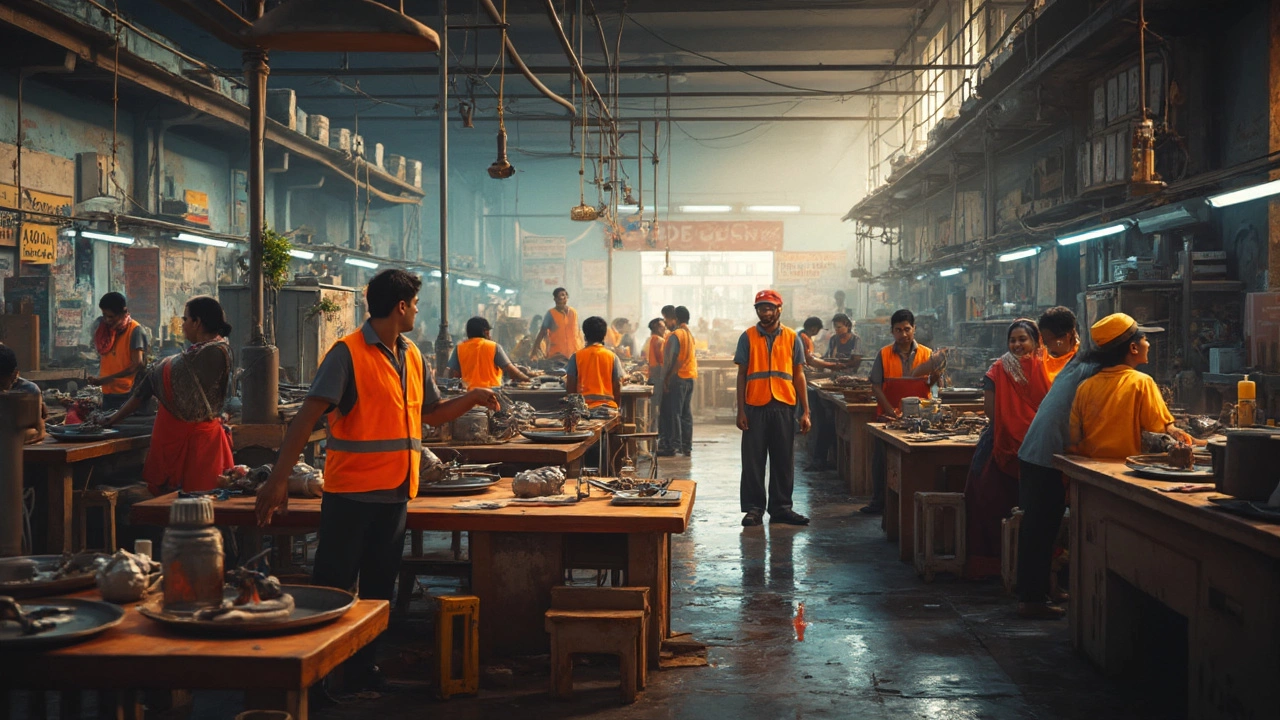
This article clears up what actually qualifies as a small manufacturing company. It breaks down recognized standards from the SBA and other sources, looks at employee numbers and revenue ranges, and explains why these definitions matter for business owners. Readers also get practical insights into perks and challenges of running small operations. You'll find real-world tips for growth and what to expect if you want to start or label your shop as a 'small' manufacturer.